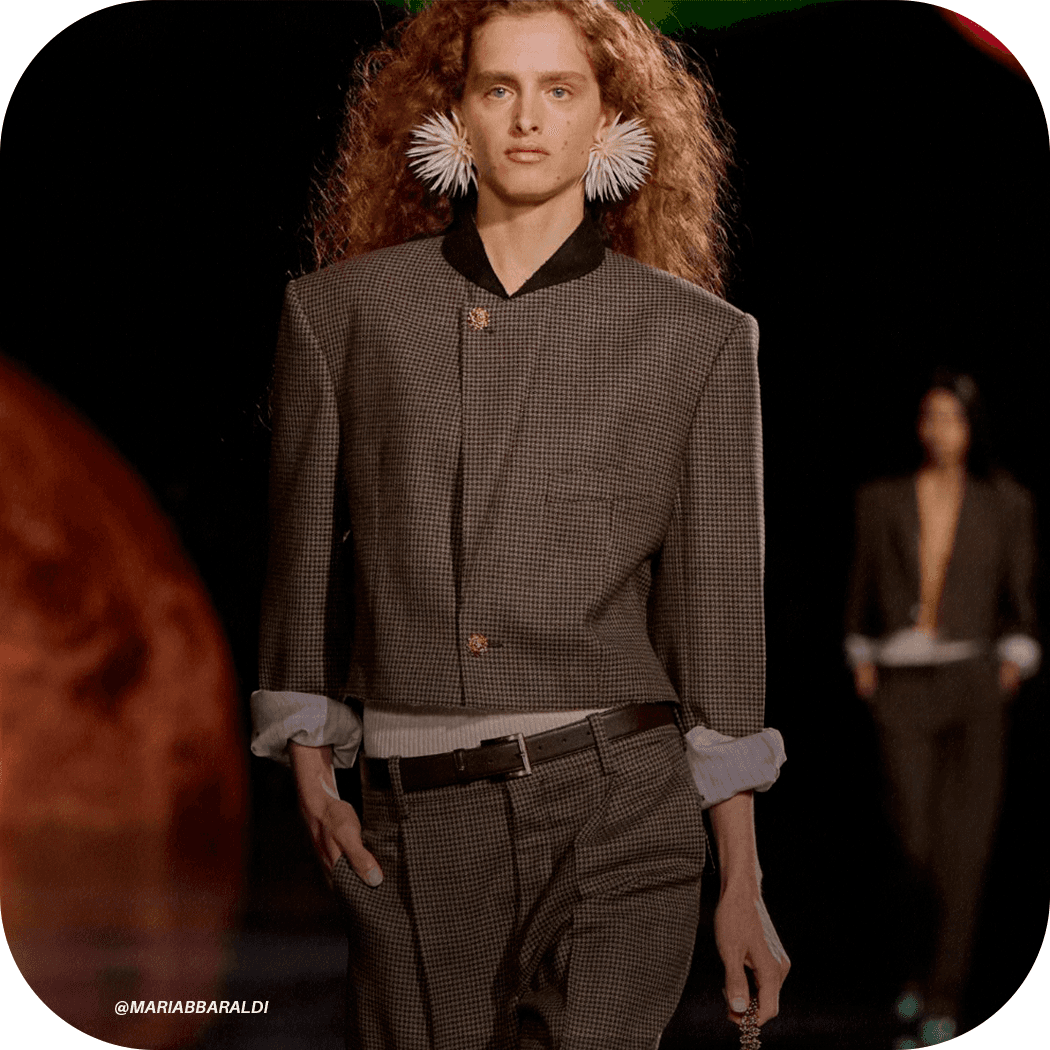

What Matthieu Blazy’s first collection reveals about identity, repositioning, and the power of a product built with intention.
When a visual code wears out
One of the most powerful luxury houses in the world, valued at around $15 billion and owner of some of the finest artisanal ateliers in existence.
And yet, Chanel has seen both its sales and public perception decline.
So what happened?
When a brand repeats the same visual code for more than thirty years, it inevitably creates a kind of wear that’s hard to disguise, even for one of the most iconic names in fashion.
While researching for this newsletter, I came across a video by Bliss Foster that put into words something I’d been trying to articulate while analyzing Matthieu Blazy’s Chanel:
House codes should be ideas and intentions that sustain a brand, and that’s not necessarily a list of product features.
Blazy himself puts it this way: what would a Chanel bag be without the quilted pattern?
It would still be Chanel, because the brand says it is. Every brand copies Chanel, yet none of them are Chanel.
Because it’s not about a specific look, it’s about heritage, positioning, and narrative.
Is it the tweed that makes Chanel what it is? No.
It’s the way Gabrielle Chanel used tweed: taking elements from the working class and men’s wardrobes and offering them to bourgeois women of her time.
When we talk about visual identity in fashion, it’s not about endless repetition or obvious associations (like “serious brand = classic blazer”). It’s about understanding where those visual associations come from.
The visual elements we see are the result of something deeper: brand history, cultural context, its founder, and its clients.
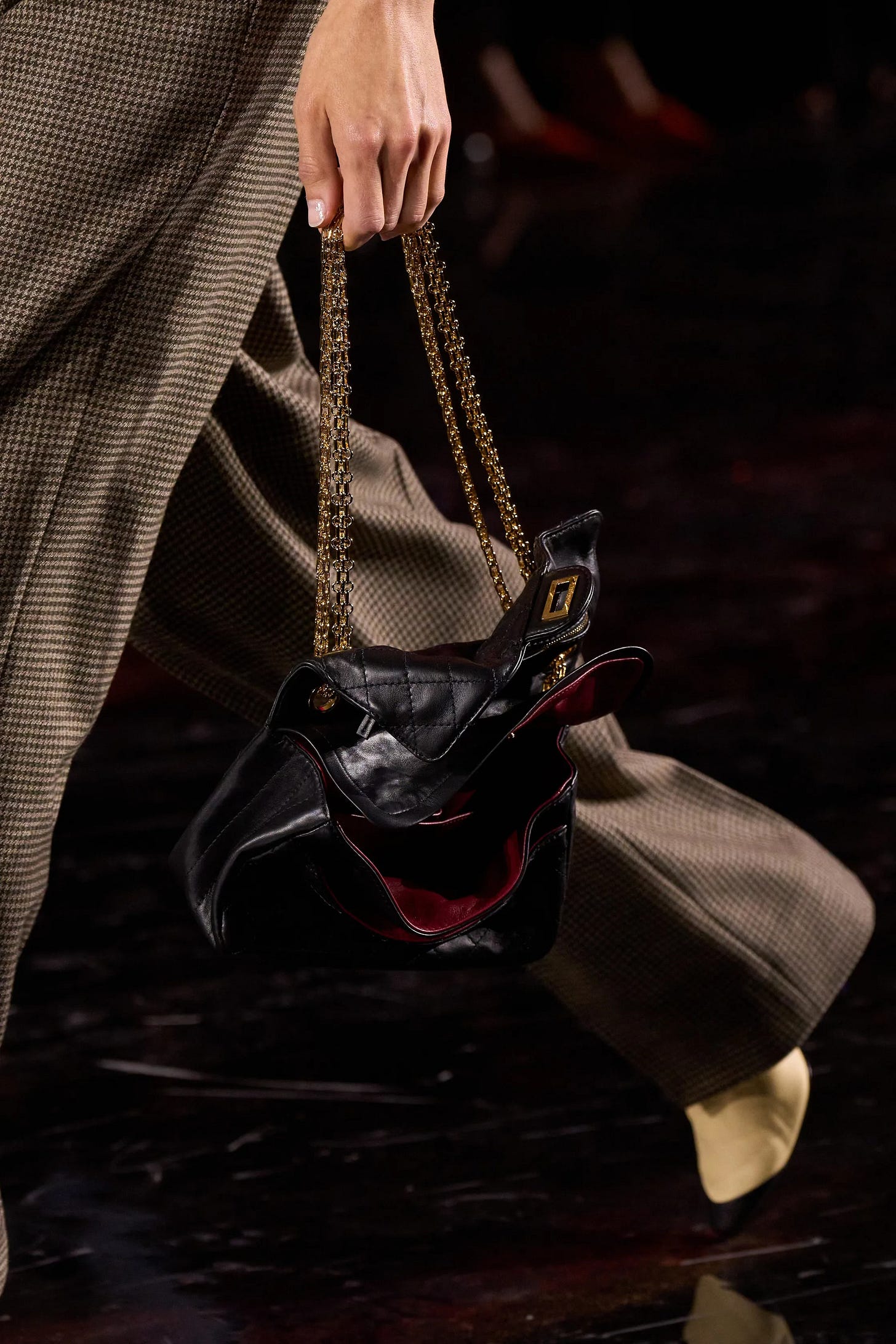
Chanel SS26 Look 1
What the data reveals about desire for the brand
Chanel’s CEO, Leena Nair, stated that one of the brand’s goals is to be seen as innovative, always ahead of its time.
At the same time, in 2024:
Revenue: $18.7 billion, down 4.3% vs. 2023
Operating profit: $4.47 billion, down 30% vs. 2023
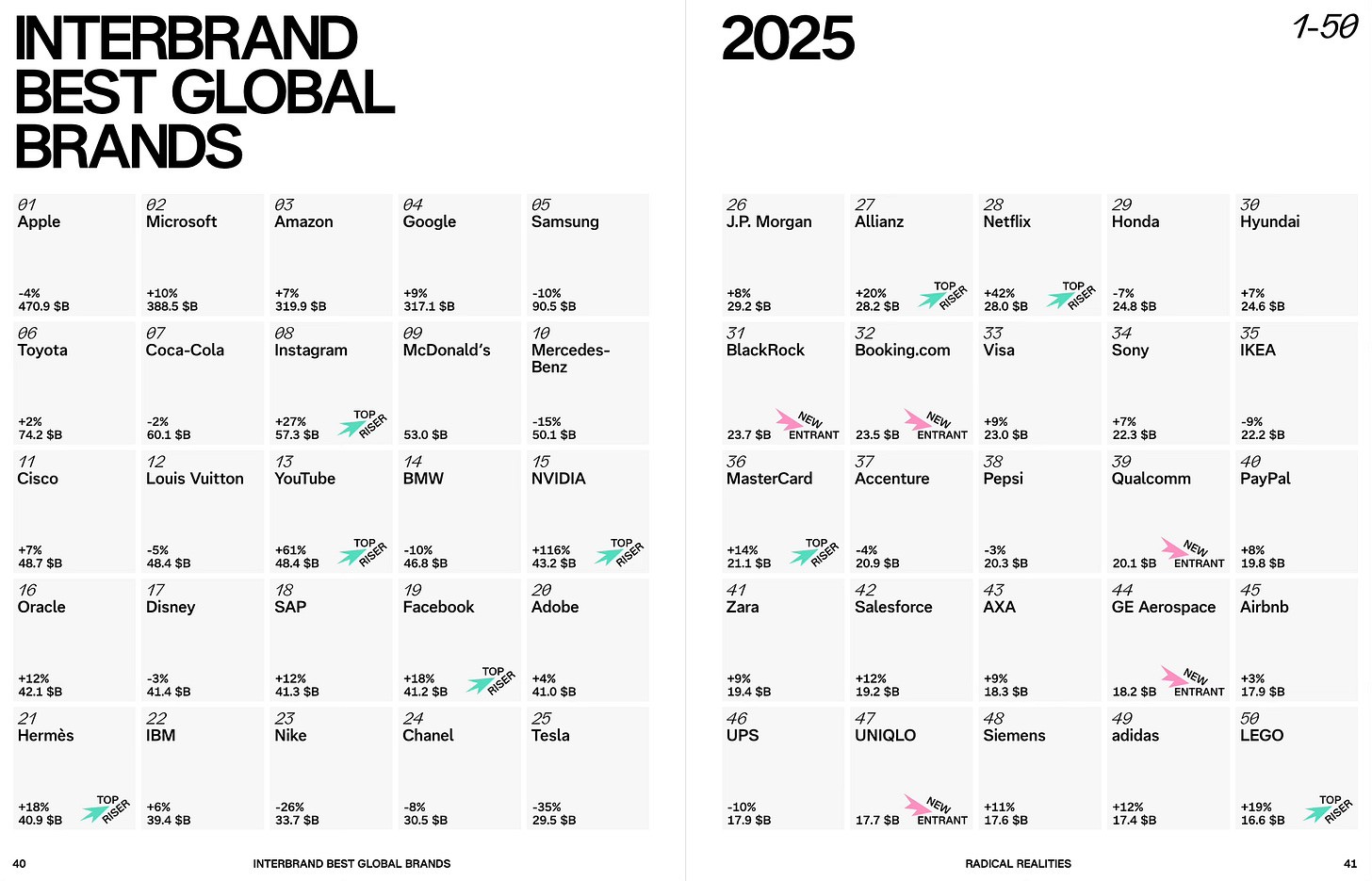
Despite the company’s optimistic statements claiming that these results were expected due to global instability, competitor Hermès continued to grow.
According to Interbrand, its Role of Brand Index rose by 18%, while Chanel’s dropped by 8%.
These numbers reflect a decline that had already been underway.
Even with a new creative direction, Chanel remained trapped within the same visual codes it had relied on for the past 40 years. Criticism of the brand’s lack of innovation already existed during the Lagerfeld era, and Virginie Viard inherited that scenario without her predecessor’s prestige.
Without a new product vision, updating marketing or brand strategy simply isn’t enough.
In a brand perception study, most respondents described Chanel as elegant, fashionable, stylish, high-quality, expensive, and exclusive — in other words, a well-defined identity.
Its positioning also remains strong: Chanel conveys exclusivity and excellence in every detail, from its investments in art to the Métiers d’Art shows and its selective presence across both physical and digital touchpoints.
According to what I call the Premium Brand Funnel, Chanel has a clearly defined sense of who it is as a brand and a solid positioning, but its recent challenges lie in its narrative and products.
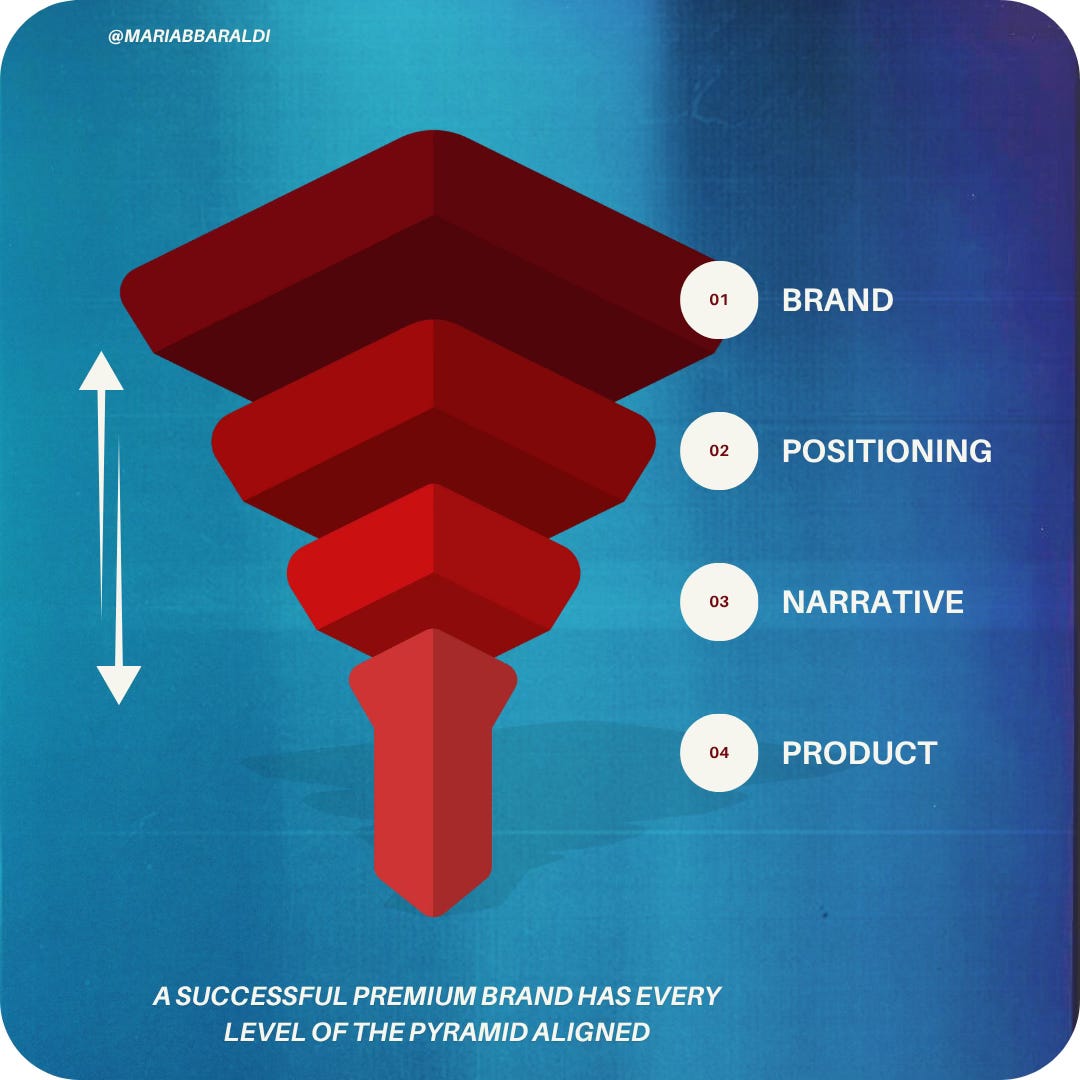
Premium Brand Funnel
In that same study, only 40% of respondents said they were drawn to Chanel because of its history or design. The majority desired the brand for its status.
That leads us to two types of loyalty:
The customer who repurchases.
The customer who has a psychological connection with the brand (the classic brand advocate, everyone knows an Apple customer who defends the brand like family).
You can rationally justify buying a luxury item, but the motivation is always emotional.
In practice, every purchase begins with emotional desire, and only materializes once it’s rationalized:
“Yes, it’s a €10,000 bag… but it’s an investment, it’ll last a lifetime.”
When luxury loses its narrative, that disconnect shows up in the products, and it becomes difficult to sustain emotional desire in a rational way.
That’s exactly what happened with Chanel: prices went up, but clients began complaining about declining quality and lack of innovation.
Chanel saw a spike in sales after 2020, but much of that came from expanding its customer touchpoints, not necessarily from a strong product or communication strategy. The recent numbers make that clear.
Now, more than ever, the brand needs to rebuild emotional connection with its clients, and that doesn’t happen through status alone, but through products that live up to what the brand promises: quality, innovation, and purpose.
One of the study’s main recommendations was precisely that: Chanel needs to tell more of its own story.
Even as a selective brand, its audience still needs to see themselves reflected in its narrative.
Matthieu Blazy’s new perspective
And that’s where Matthieu Blazy comes in.
He understood that to transform Chanel without erasing it, he would need to reinterpret its history, not repeat it. The codes remain, but they’ve gained new movement.
Chanel’s sharp lines are now softer, sometimes even curved.
Gone is the stiff “rich grandmother” image à la Bunny MacDougal, in comes a younger, chic, more easygoing woman, with a subtle sensuality.
It goes back to what I wrote about Louise Trotter’s Bottega: “the coolest women you know are never entirely put together.”
That’s exactly the zeitgeist. In a world where everyone is trying to construct an image, unintentional authenticity has become the ultimate symbol of desire.
Blazy understood that, and brought that sense of effortlessness to Chanel.
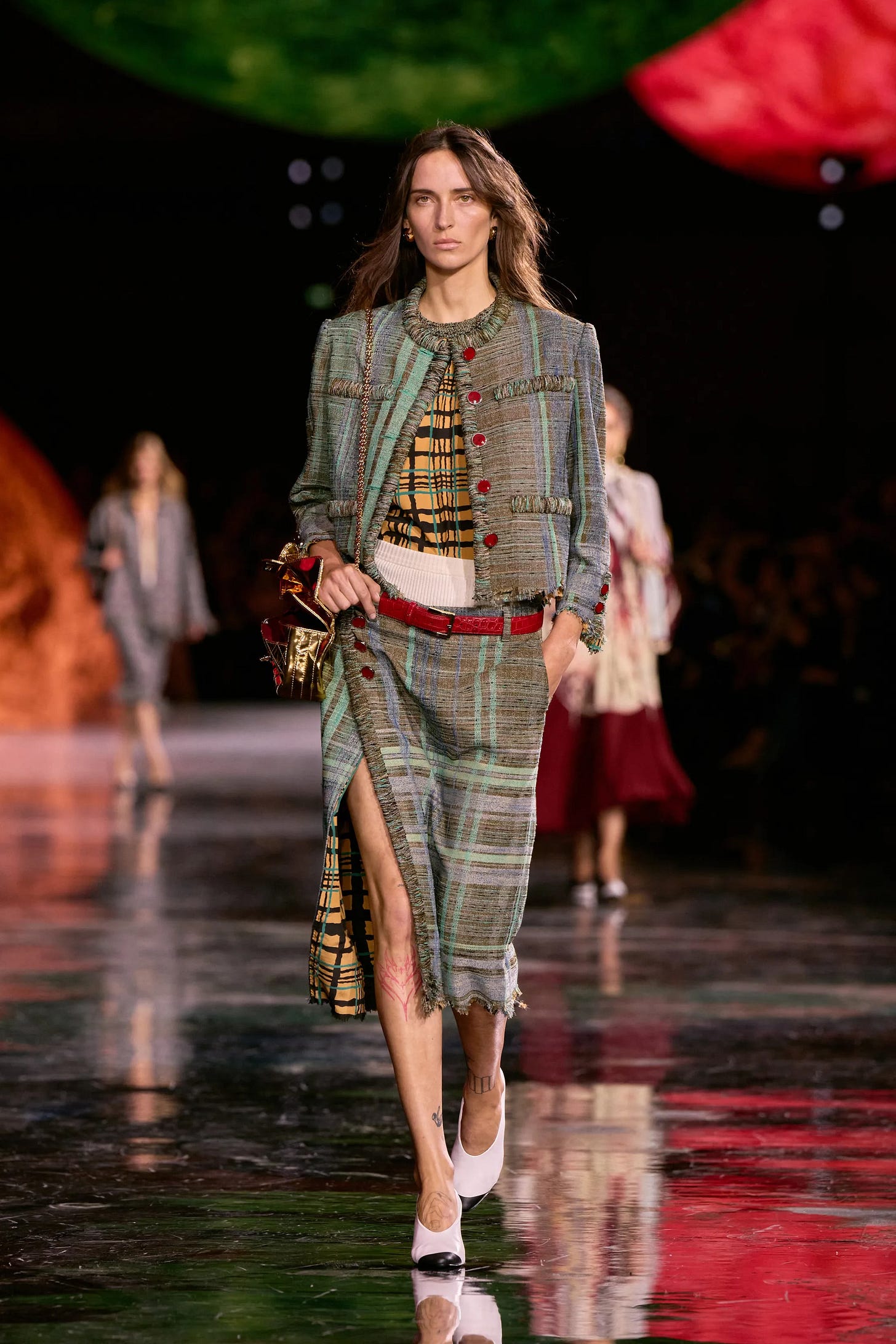
Chanel SS26 Look 46
In one of his interviews, Matthieu made a remarkably observation about Karl Lagerfeld’s Chanel:
“But I realized that what we saw from Karl was really his take on Chanel, and there were a lot of stories that weren’t told. What I found interesting is that he created a panoply. He created a costume to look like Chanel, and it became very much about the character Chanel. You have the codes: the jacket, the pearls, the tweeds, always juxtaposed together to create a kind of system. And he collaged it to his time.”
Today, when people think of wearing Chanel, they imagine a fixed image. When a brand becomes a uniform, the clothing stops following the woman, and starts demanding that she adapt to it.
It’s such a rigid idea that instead of creating a mood, it creates a rule.
But in Blazy’s first collection, we saw movement everywhere.
When clothes show that much motion (even within straight lines) it feels like they’re about fitting the body, about becoming part of someone (that’s why he emphasizes garments with raw edges, or a crumpled bag that looks too worn).
It’s about the person living in the clothes, not the clothes defining the person.
It’s the same logic behind people saying a Hermès Birkin only becomes truly chic once it’s worn out, because it shows it was used, not kept in a closet like a museum piece.
The new narrative came from the past: Gabrielle Chanel as a woman in love.
Blazy shared that, while studying her relationship with Boy Capel, he realized the brand’s foundation was born from an emotional gesture: love.
Even though the Chanel style is known for its tomboy silhouette, it makes perfect sense that, when revisiting this story, it would take on lightness, softness, and fluidity.
He speaks about the fusion of masculine and feminine, not as an aesthetic, but as an emotional expression: a woman who wears men’s clothing not to appear strong, but to feel close to the one she loves.
Chanel has always been about elegance freed from artifice, about refined rusticity.
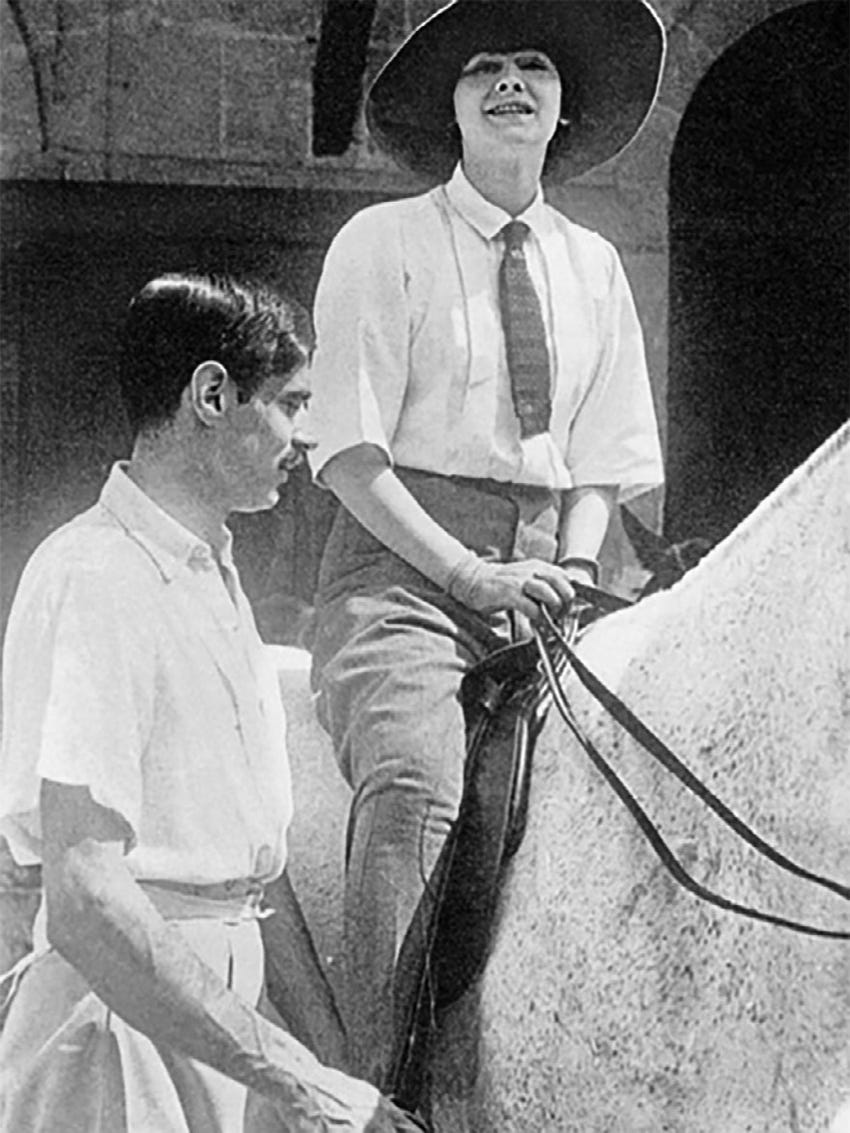
Arthur “Boy” Capel with Chanel on horseback, 1908, at Chateau de Royallieu. Source: Vaughan, Sleeping with the Enemy, 7.
Even the show’s soundtrack reinforced that idea.
Blazy frees the Chanel woman from the armor and rigidity of time.
He repositions the brand through movement, emotion, and truth; and he does it through the product itself.
This Chanel is about the love that built the brand, and the passion of an industry determined to make it endure.
How to apply this to your brand
But what about your brand?
Maybe you don’t have Chanel’s budget, or a team managing historical archives.
But could you also be losing desirability? Sitting on unsold products? Seeing clients who don’t come back?
If you feel your brand is generating less desire, or that it’s lost its essence…
Repositioning doesn’t start with your logo.
Or with Instagram.
It starts with the product.
A well-thought-out product is a cornerstone of positioning: it shows (without saying) who you are as a brand.
That’s why it’s important to take a few steps back to understand where your brand came from, why it exists, and how that story intertwines with your own.
When a client touches, wears, or experiences something that represents your brand, that’s when they truly understand who you are, and decide whether they want to come back.
At BPA Method, that’s exactly what we work on: aligning story + positioning + product so your brand doesn’t have to pretend to be something it’s not.
Visual branding can change, and marketing can help, but what sustains a brand in the long run is coherence, not aesthetics.
→ Want to know if your brand needs this kind of repositioning? Get in touch for a brand diagnosis at contact@baraldi.co.

Let’s keep in touch.
Discover more about high-performance web design. Follow us on Twitter and Instagram.

