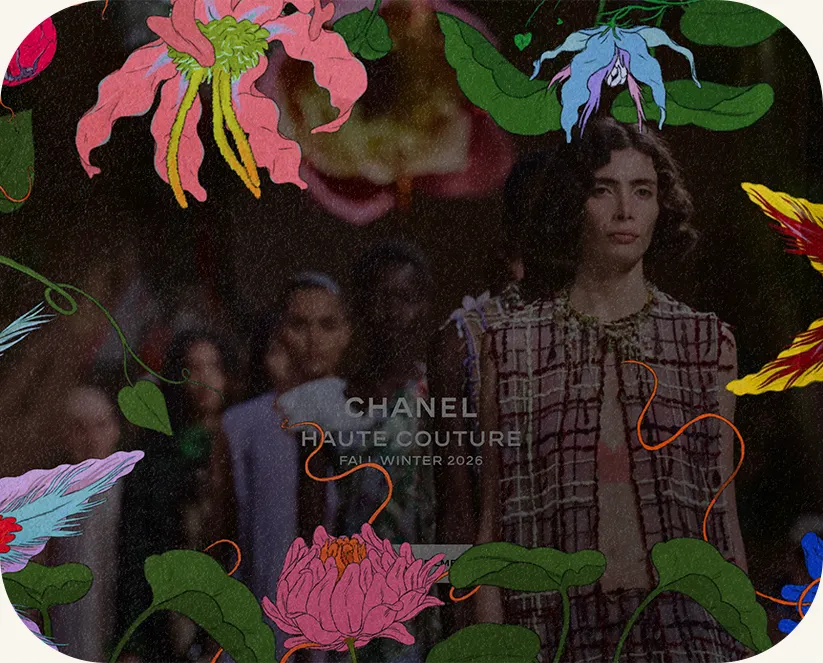

A customer arrives from a campaign, buys the exact piece she saw, and never comes back for anything else. Repeat purchase doesn’t track with what you’re spending to acquire her, cross-category barely moves, and the line you spent a season building behaves like a backdrop for two or three heroes.
The reflex is to read this as an acquisition problem, so the budget goes back into paid, the retargeting gets tighter, a few new drops go up to give her a reason to return. When she clicks through to a second product, the page has nothing to tell her, so she has no reason to go any further.
The fashion industry got comfortable not talking about its products, a strong aesthetic and the desire to belong were enough to close the sale. The product transparency that has been building over the last few years, mostly inside beauty, is now reaching fashion as well, and calling a brand luxurious or premium has stopped carrying much weight on its own.
What beauty was forced to learn
Over the last few years, customers as a whole have been trained by the skincare industry, and by the wellness culture before it, to ask a specific set of questions before they buy anything, what does this do, who is it for, why does it cost what it costs, what comes after it. A beauty brand selling an $80 serum had no way around answering all of that, because a serum can’t justify its price by how it looks, so the category built an entire layer of explanation, ingredient, function, result, the next step in a routine. The Ordinary turned that layer into the product itself, the customer learns to read a formulation with something close to clinical confidence, and once she can read the products, telling her the dupe does the same thing stops working.
Call it value literacy, the trained reflex of interrogating worth before committing to it. It started with food labels, hardened in skincare, and it has come loose from the wellness aesthetic that produced it, which is why it outlasts the pendulum, the clean-girl look is already cycling out and the scrutiny it taught is staying. The customer who learned to ask whether a serum is worth it now asks the same of a coat.
When Ferragamo handed a content creator a €2,400 bag and let him cut it open on camera to judge whether the construction earned the price, that was a house recognizing that the verdict now comes from the customer’s scrutiny rather than the brand’s claim, and deciding to stand on the right side of it. The wider number is the harder one to sit with, close to two thirds of consumers no longer believe a premium brand performs any better than a mass one, so when your page stays quiet, she fills the silence with the cheaper assumption and the nearest dupe.

Composition is the floor
Here is the part that matters for you, and the part that is easy to get wrong. The pull right now is toward a fabric-composition table or a sustainability disclosure, the literal reading of literacy, and on its own it stops short of what actually moves her. Beauty’s depth came from knowing the job of every product precisely, the ingredient list was only the logical result of a good SKU.
The fashion version of an ingredient deep dive is the role of the garment, what job it does in her wardrobe, what it replaces, where it sits relative to everything else you make, what she is meant to reach for after it. A page reads as silent when the product underneath it has no defined role, and you can’t explain a role you never assigned.
A few fashion brands already work this way, and the tell is that their depth comes from product logic, not from a list of components or eco-credentials. Cuyana designs by job rather than by piece, a single bag built to move a customer from the office to the evening, which is why its line reads as a wardrobe with roles instead of a catalog. Vollebak names each product as its own promise and spends the page explaining what problem it solves and how, which is the cleanest proof that the depth beauty has is reproducible in clothing once the product is genuinely understood.
The page can say why this particular wool was chosen, that it holds warmth without the bulk, or that it sits at the rare meeting point of comfort and an accessible price
It can say what the cut does for her body, a pocket placed to flatter the line rather than only to exist. It can say how the pieces relate, that the blouse she bought last month was built to work under the jacket she is looking at now.
That is the layer that turns a description into a reason, and it’s the layer most fashion pages still skip. A cost breakdown alone on a product with no defined role only tells the customer exactly what she is overpaying for.
So the real work sits above the page, in the architecture of the line itself. When every product has a job, an entry piece that recruits her, a piece that does the daily work and proves the quality, a piece that exists to build perception, the page has something true to say about each one, the customer can be led from the first purchase to the second, and the discounts and the paid retargeting stop carrying weight they were never built to hold. A premium brand doesn’t grow past the coherence of the experience it delivers, and value literacy has simply made that ceiling visible, your customer now arrives fluent in a question your product was never structured to answer. Defining that structure, the role of every product and how the line moves from one piece to the next, is exactly the work the BPA Method does!

Hi! I’m Maria
If this made you look at your own line and wonder which pieces actually have a role and which are just holding a price point, that is the work I do. I help fashion founders connect brand strategy with product planning, so the collection stops depending on a campaign to make sense and starts working as a system.
If you want to see how this could work for your brand, you can read more about my method at https://baraldi.co , or simply reply to this email at contact@baraldi.co and tell me what you’re currently struggling with.
Wishing you clarity (and a line that finally explains itself)!
See you in the next essay!
Let’s keep in touch.
Discover more about high-performance web design. Follow us on Twitter and Instagram.

